
Gaming
Why Chargebacks Happen in Gaming (And How to Stop Them)
Chargebacks in gaming cost studios revenue, fees, and processor trust. Here are the six most common causes and a prevention playbook built for studios in 2027.
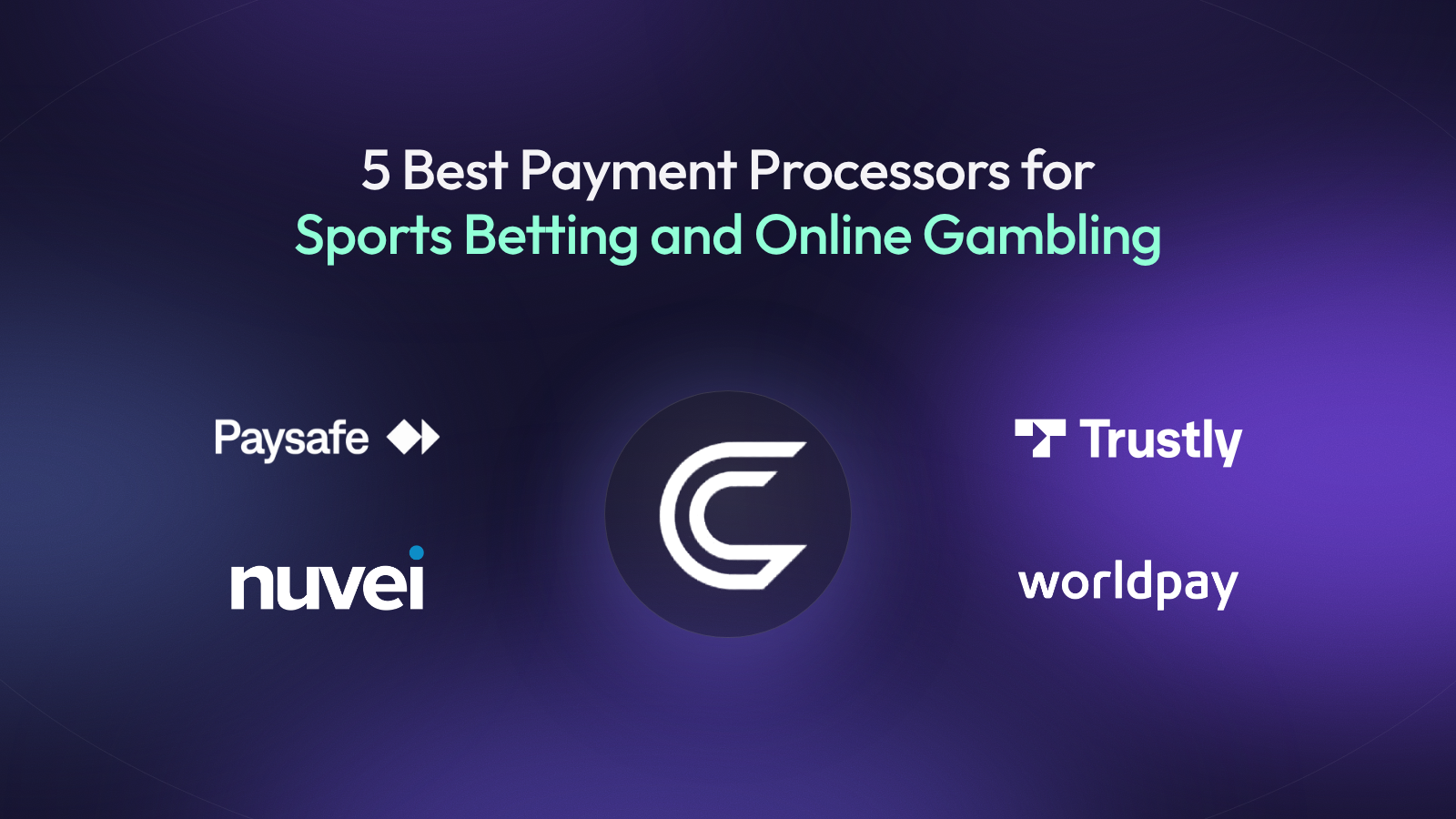
Sportsbook deposits fail when processors can't handle high-risk volume. Compare 5 payment processors for sports betting and online gambling operators in 2027.
Updated October 2026 · By Ben Meeder, CTO and Co-Founder
Sports betting and online gambling operators should judge a payment processor on deposit approvals first, then local rail coverage, payout speed, chargeback terms, and acquirer redundancy. Pricing is custom across the board. Card-heavy books benefit from multi-acquirer routing, wallet-heavy player bases fit Paysafe, multi-region launches fit Nuvei, bank-funded play fits Trustly, and enterprise card volume fits Worldpay. Before signing, confirm underwriting for every licensed jurisdiction and payout speed by rail.
Choosing payment processors for sports betting comes down to one number most operators feel before they measure it: how many deposits actually go through. A declined deposit on a Sunday afternoon before kickoff rarely gets retried. That player opens a different app.
US commercial sports betting revenue hit $16.89B in 2025, up 22.6%, and iGaming climbed 27.6% to $10.73B, according to the American Gaming Association's State of the States 2026 report. Below, we compare five processors on methods, markets, payout speed, disputes, and setup.
Quick answer: Here's a quick reference by operator type:
| Business type | Primary need | Best fit |
|---|---|---|
| Operator scaling card deposits and fast withdrawals | Higher approvals, instant player payouts, one integration | Coinflow |
| Operator with wallet-heavy player base | Skrill, Neteller, and paysafecard acceptance | Paysafe |
| Operator expanding across several regions | Local bank and instant payout rails by market | Nuvei |
| Operator prioritizing bank-funded play | Pay-by-bank deposits and withdrawals, bank-verified onboarding | Trustly |
| Enterprise operator with high card volume | Large-scale acquiring, managed dispute handling | Worldpay |
Sportsbooks should judge a processor on approvals first, then on rail coverage, payout speed, risk handling, and onboarding fit. Gambling's high-risk merchant category code means many issuers decline by default.
Declines and disputes are tightly linked here. Issuer suspicion that causes declined player deposits usually resurfaces later as friendly fraud and monitoring-program exposure.
Underwriting is where most sportsbook processor relationships are won or lost. This short video shows the process from the processor's side.
Every provider here quotes gambling pricing custom, so the model and best-fit columns matter most at this stage. Methods, payout speed, and chargeback protection are compared after the provider breakdowns.
| Provider | Model | Best for | Pricing |
|---|---|---|---|
| Coinflow | Multi-acquirer payments infrastructure | Approvals plus instant payouts | Custom |
| Paysafe | Processor with wallet brands | Wallet-heavy player bases | Custom |
| Nuvei | Global processor and acquirer | Multi-region local methods | Custom |
| Trustly | Pay-by-bank network | Bank-funded play | Custom |
| Worldpay | Enterprise acquirer | High card volume | Custom |
Coinflow, Paysafe, Nuvei, Trustly, and Worldpay each cover a different part of the operator stack, from card approvals to wallets to pay by bank. Gambling pricing is almost always custom, so expect a quote driven by your markets, volume, and dispute history.
Best for: Sportsbooks and casinos that want higher card approvals and instant withdrawals from one provider.
Coinflow is payments infrastructure that connects an operator to cards, bank rails, and local wallets through one integration, routing each transaction across multiple acquirers for approval, cost, and speed.
Watch out for: Gambling coverage depends on your licenses, so confirm each jurisdiction during underwriting. You'll still want a dispute playbook, since gaming chargebacks count toward card-network monitoring ratios.
Best for: Operators whose players already fund play from Skrill, Neteller, or paysafecard balances.
Paysafe is a processor that also owns consumer wallet and eCash brands. Its iGaming solution bundles cards, wallets, eCash, and local methods behind one integration.
Watch out for: Wallets and vouchers only help where players already hold those accounts, so check adoption market by market.
Best for: Operators launching in several regions that want one provider for cards and local bank methods.
Nuvei is a global processor and acquirer citing 720+ alternative payment methods and local acquiring in 52 markets.
Watch out for: US state approvals aren't listed publicly, and Brazil coverage traces to a 2024 licensing deal, so confirm your exact markets.
Best for: Operators that want bank-funded deposits and instant withdrawals with bank-verified player data.
Trustly is a pay-by-bank network. Players connect a bank account instead of a card, which sidesteps card-network gambling declines.
Watch out for: Card acceptance needs a second provider, and Trustly ID doesn't list age verification.
Best for: Large operators with heavy card volume that want an enterprise acquirer and optional managed disputes.
Worldpay, now part of Global Payments, is an enterprise card acquirer and gateway with a dedicated gaming team.
Watch out for: Supported gaming markets aren't listed publicly, and your contract may sit with a Global Payments entity.
Coverage and payout speed decide how players feel about your sportsbook, and chargeback protection decides how much risk stays with you. Here's how the five compare:
| Provider | Coverage | Payout speed | Chargeback protection |
|---|---|---|---|
| Coinflow | Cards, wallets, ACH, SEPA, PIX | Instant in 40+ countries | Indemnified on approved card-not-present transactions |
| Paysafe | Cards, Skrill, Neteller, paysafecard, pay by bank | Varies by method | US Pay by Bank indemnified |
| Nuvei | Cards, e-wallets, RTP, Interac, SEPA Instant | Instant to cards and banks | Dispute tools |
| Trustly | 99%+ of US bank accounts; Pay N Play in Europe | Seconds where eligible | Not published |
| Worldpay | Cards, wallets, PIX, Open Banking | Real-time to cards and wallets | Managed dispute service |
See how Novig lifted acceptance from 86% to about 95% after moving beyond ACH-only.
Read the case study →PIX in Brazil, SEPA Instant in Europe, and RTP in the US matter most, because each moves deposits and winnings bank-to-bank in seconds.
Regulated betting went live on Jan. 1, 2025. Under Ordinance 615/2024, deposits and withdrawals must move by PIX, TED, or debit and prepaid cards, with credit cards and boletos prohibited, per Mattos Filho's summary of the ordinance.
PIX set a one-day record of 313.3M transactions on Dec. 5, 2025, as Forbes Brasil reported from Banco Central data.
Euro-area payment providers had to send instant transfers, with verification of payee, by Oct. 9, 2025, according to the European Central Bank.
Legal sports betting operates in 39 states plus Washington, D.C. RTP hit a record of about 2.27 million transactions worth $8.62B on May 1, 2026, per The Clearing House.
Operators should get specific answers on markets, approvals, payouts, and risk before signing:
Sportsbooks choose Coinflow because it connects them to every payment network through one integration and makes those networks work as one. Each deposit is routed for the best approval, cost, and speed, so more players get into the game on the first try.
Operators typically see a 3–7% approvals lift over traditional processors, settlement at T+5 seconds, 24/7/365, and instant payouts in 40+ countries. Indemnification on approved card-not-present transactions, plus underwriting up front, lets your team plan for the Super Bowl instead of bracing for it.
You can be live in weeks, not quarters, with a forward-deployed engineer who stays on after launch.
How a provider treats gambling as a category matters as much as its list of payment methods. We underwrite licensed sportsbooks and casinos up front, with volume and seasonality mapped well before launch, so game-day peaks don't trip freezes.
Talk to our team about routing, local rails, and instant payouts for every market you're licensed in.
Talk to our team →Pick the processor that approves the most deposits in your licensed markets and pays out on the rails your players use. Card-heavy books prioritize multi-acquirer routing, wallet-heavy markets lean on Paysafe, and bank-funded books add Trustly.
Issuers treat gambling as high-risk and often decline by default, especially for new players and large first deposits. Routing across multiple acquirers, adding local bank rails, and a smooth checkout for high-value players all raise approvals.
Most processors pass disputes back to the operator with tools or managed services to fight them. Coinflow provides fraud and chargeback indemnification on approved card-not-present transactions. Operators should still manage dispute ratios under Visa's Acquirer Monitoring Program (VAMP).
Expect to provide gaming licenses for each jurisdiction, ownership and Know Your Business (KYB) documents, and processing history. Processors that board the vertical should have a clear process for onboarding high-risk merchants.
This content is for informational purposes only and does not constitute financial, legal, or investment advice.

Ben is the CTO and Co-Founder of Coinflow, where he leads the engineering team connecting traditional payment rails with stablecoin technology to enable instant global settlement for trusted, cross-border commerce.
Gaming
Chargebacks in gaming cost studios revenue, fees, and processor trust. Here are the six most common causes and a prevention playbook built for studios in 2027.

Gaming
Which deposit and withdrawal methods do bettors trust in the US, Brazil, the UK, Europe, and Canada, and what rules shape each one?
Gaming
Players abandon checkouts that skip their local payment methods. Compare 7 gaming payment solutions for 2027 on acceptance, payouts, and fraud coverage.