
Marketplaces
Why Slow Payouts Are Causing Sellers to Leave Your Marketplace
Slow marketplace payouts push your best sellers to competitors. See how payout speed shapes seller retention, liquidity, and long-term platform growth.
How can a marketplace pay sellers in seconds without fronting capital or taking on extra chargeback risk? Here's the five-step playbook we see work.

Updated October 2026 · By John Thomas Lang, Head of Marketing
Sellers now choose platforms on pay speed: in a late-2025 Worldpay survey, 81% of U.S. gig workers said they'd prioritize a platform that pays instantly. To offer instant payouts safely, settle pay-ins in seconds so you never front capital, screen fraud before money moves, and pay out on local rails like real-time payments (RTP), Push to Card, SEPA Instant, UK Faster Payments, and PIX. Then let each seller choose standard, same-day, or instant.
Instant payouts for marketplaces have gone from a perk to a baseline. Sellers who restock with yesterday's revenue judge a platform by how fast they can withdraw, and if cash takes days, they list elsewhere.
Making that work takes four things: funds that settle in seconds, chargeback protection, rails that reach each seller's bank or card, and solid onboarding. Here's how to put them together.
Pay speed now shapes which platform sellers choose. In Everee's 2025 Gig Driver Report, a May 2025 survey of 419 U.S. drivers, 85% called fast access to earnings "very" or "extremely important" when choosing a platform, and 70% preferred daily or instant pay.
A late-2025 Worldpay survey of U.S. gig workers found similar results:
Resellers and creators on marketplaces act the same way, because most of them get paid like gig workers: per sale, with no salary to cover the gap.
Yes, and volume is climbing fast. Settled payments on the Federal Reserve's FedNow Service rose from about 2.1 million in Q2 2025 to nearly 5 million in Q2 2026 per FedNow quarterly volume statistics. That's more than double in a year.
Private-sector rails are growing too. The Clearing House reports its real-time payments (RTP) network handled 150 million transactions worth $621B in Q3 2026.
| Rail | Where it pays out |
|---|---|
| RTP | U.S. bank accounts |
| Push to Card | Eligible debit cards |
| SEPA Instant | Euro-area bank accounts |
| UK Faster Payments | UK bank accounts |
| PIX | Brazilian bank accounts |
Here's a short primer on how real-time payment rails work and why they've become practical for everyday payouts.
Instant payouts get risky when money leaves before the sale is final. Many platforms either front payouts from their own balance while buyer funds are in transit, or release funds before fraud windows close.
Fronting ties up working capital that grows with every seller. Paying early means a chargeback can land after the seller has withdrawn. Platforms facing slow marketplace payouts often get stuck choosing between speed and safety.
Fix settlement, risk, and rail coverage together. Here's the sequence we see work.
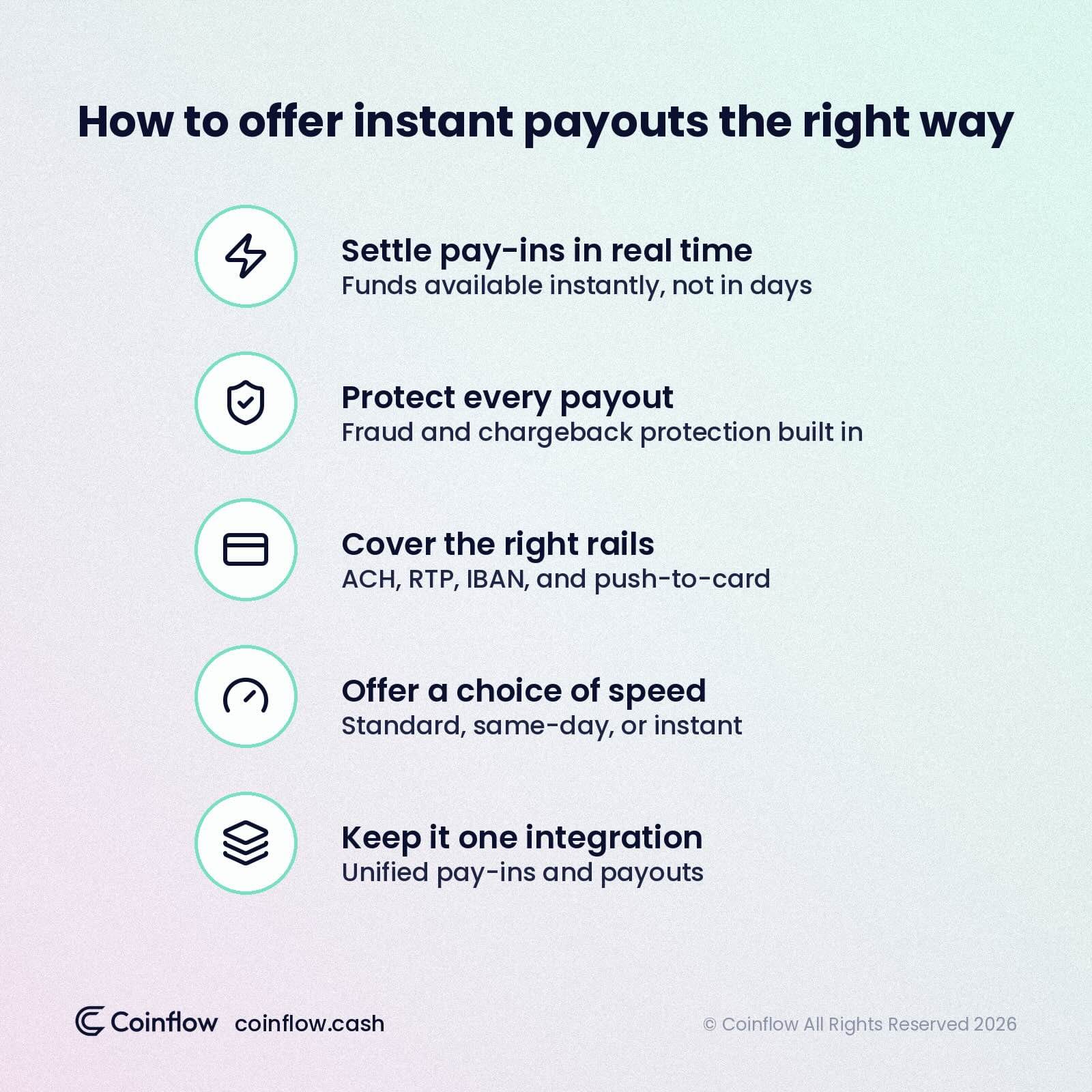
When pay-ins settle at T+5 seconds, 24/7/365 (weekends included), you pay sellers from settled revenue and never fund the gap yourself.
Real-time fraud decisions at checkout stop bad transactions before money moves. Fraud and chargeback indemnification on approved card-not-present transactions means a dispute after payout doesn't come out of your margin.
Sellers want money in their own account or card, in their own currency. That means RTP and Push to Card in the U.S., plus SEPA Instant, UK Faster Payments, and PIX for sellers abroad. In the euro area, the ECB's instant payments standard makes funds available within 10 seconds, 24/7/365.
Sellers abroad also bring FX and compliance checks into every withdrawal, so transparent conversion matters as much as speed.
Offer standard, same-day, and instant tiers, and price instant to match its cost. Ticket resale platforms already run tiered seller payouts this way.
Running pay-ins on one provider and payouts on another means two sets of records and a daily matching job. One integration makes payment reconciliation real time instead of a month-end project.
See how Courtyard.io grew active sellers 1,350% and cut chargebacks from 1.42% to 0.28%.
Read the case study →Fast payouts are only safe when you know who you're paying. Know Your Customer (KYC), Know Your Business (KYB), anti-money laundering (AML), and sanctions screening at signup let you release funds without manual review.
Strong onboarding moves the hard questions to day one, so a seller's first instant withdrawal clears like their hundredth.
Coinflow is payments infrastructure that connects your marketplace's pay-ins and payouts to every payment network through one integration. Pay-ins settle at T+5 seconds, 24/7/365, and instant payouts run on RTP, Push to Card, SEPA Instant, UK Faster Payments, and PIX in 40+ countries, with each seller picking their speed.
On the pay-in side, merchants see a 3–7% approvals lift over legacy processors and typically see 20–35% lower acceptance costs. Fraud and chargeback indemnification on approved card-not-present transactions protects payouts after funds leave. Per-transaction splits and pre-built payout UIs keep every payment on one ledger.
Most teams are live in weeks, not quarters, with a forward-deployed engineer who co-builds the integration and stays on after launch. Your sellers get paid at the speed they pick, and your team never fronts the gap.
Talk with our team about instant payouts on RTP, Push to Card, SEPA Instant, UK Faster Payments, and PIX through one integration.
Talk to our team →Many do. In Worldpay's late-2025 survey, 67% of gig workers said they'd pay a small fee for immediate access. Keep a free standard tier alongside it.
Paying out before funds settle raises exposure. Real-time fraud screening plus chargeback indemnification on approved card-not-present transactions keeps it manageable.
Yes, if your provider supports local instant rails in each seller's country. Coinflow supports instant payouts in 40+ countries with transparent FX and no opaque markup.
This content is for informational purposes only and does not constitute financial, legal, or investment advice.

John Thomas Lang is Head of Marketing at Coinflow and a two-time $1B-unicorn brand builder known for turning early-stage companies into high-growth, category-defining businesses.
Marketplaces
Slow marketplace payouts push your best sellers to competitors. See how payout speed shapes seller retention, liquidity, and long-term platform growth.

Fintech
Real-time payments are projected to hit 22% of global transaction volume by 2028. Here's how marketplaces, e-commerce, gaming, payroll, remittance, and fintech platforms are using instant settlement to drive real business outcomes.
Marketplaces
How do you turn liquidity into growth? For Courtyard.io, the answer was clear: give sellers instant access to their funds and watch growth happen.