

Marketplaces
How to Offer Instant Payouts to Your Marketplace Sellers
How can a marketplace pay sellers in seconds without fronting capital or taking on extra chargeback risk? Here's the five-step playbook we see work.
Most marketplaces don’t get burned by high-risk sellers. They get burned by poor onboarding design. See how to approve sellers without losing control.

Most marketplaces don’t get burned by high-risk sellers because they ignored compliance. They get burned because they approved sellers without controlling exposure.
I’ve seen this play out time and again. A merchant passes identity checks. They sell legitimate products. On paper, they look fine. But once the money starts moving, the reality sets in: delayed fulfillment, refund-heavy models, or categories that attract regulatory heat.
The challenge for marketplace teams isn’t whether to onboard these sellers. It’s about doing it without turning payouts, disputes, and liquidity into constant emergencies.
This is a practical approach to onboarding high-risk merchants—not by adding friction everywhere, but by treating payouts and money movement as core parts of the onboarding design.
In the marketplace world, 'high risk' is rarely about a single red flag. It is simply a measure of exposure growing faster than trust.
Businesses with delayed fulfillment or regulated products naturally increase dispute and refund exposure.
Newly formed entities or undercapitalized sellers often cannot absorb a refund spike, leaving you to hold the bag.
Operating across jurisdictions adds layers of sanctions complexity and varying consumer protection laws.
High ticket sizes or digital goods with instant delivery can accelerate the realization of losses.
A seller isn’t truly 'high risk' until your marketplace is financially on the hook. Risk becomes dangerous the moment funds leave the platform.
Most onboarding systems fail not because they’re careless, but because they rely on extremes.
Some marketplaces apply heavy verification—long forms, document uploads, manual reviews—to everyone. This hurts the majority of your legitimate businesses. If you treat every seller like a criminal, good merchants will churn before they ever create value.
– Tamille Suhir, Risk & Compliance Analyst @ Coinflow
Heavy friction everywhere is a blunt tool. It reduces growth without meaningfully reducing exposure.
Other teams approve quickly and let money flow, planning to catch bad actors later. This works until the chargebacks hit. Once funds are disbursed, fixing risk becomes exponentially more expensive. You aren't managing risk; you're reacting to fire drills.
When onboarding is poorly designed, operations and finance feel it first.
Manual reviews pile up. Teams scramble to investigate sellers after problems surface. Liquidity stress appears when refunds and disputes outpace settlement. Instead of proactively controlling risk, teams react to incidents.
At that point, onboarding stops being a growth function and becomes a fire drill.
High-risk onboarding works best when it’s adaptive. Not everyone should move at the same speed, nor should everyone get the same controls.
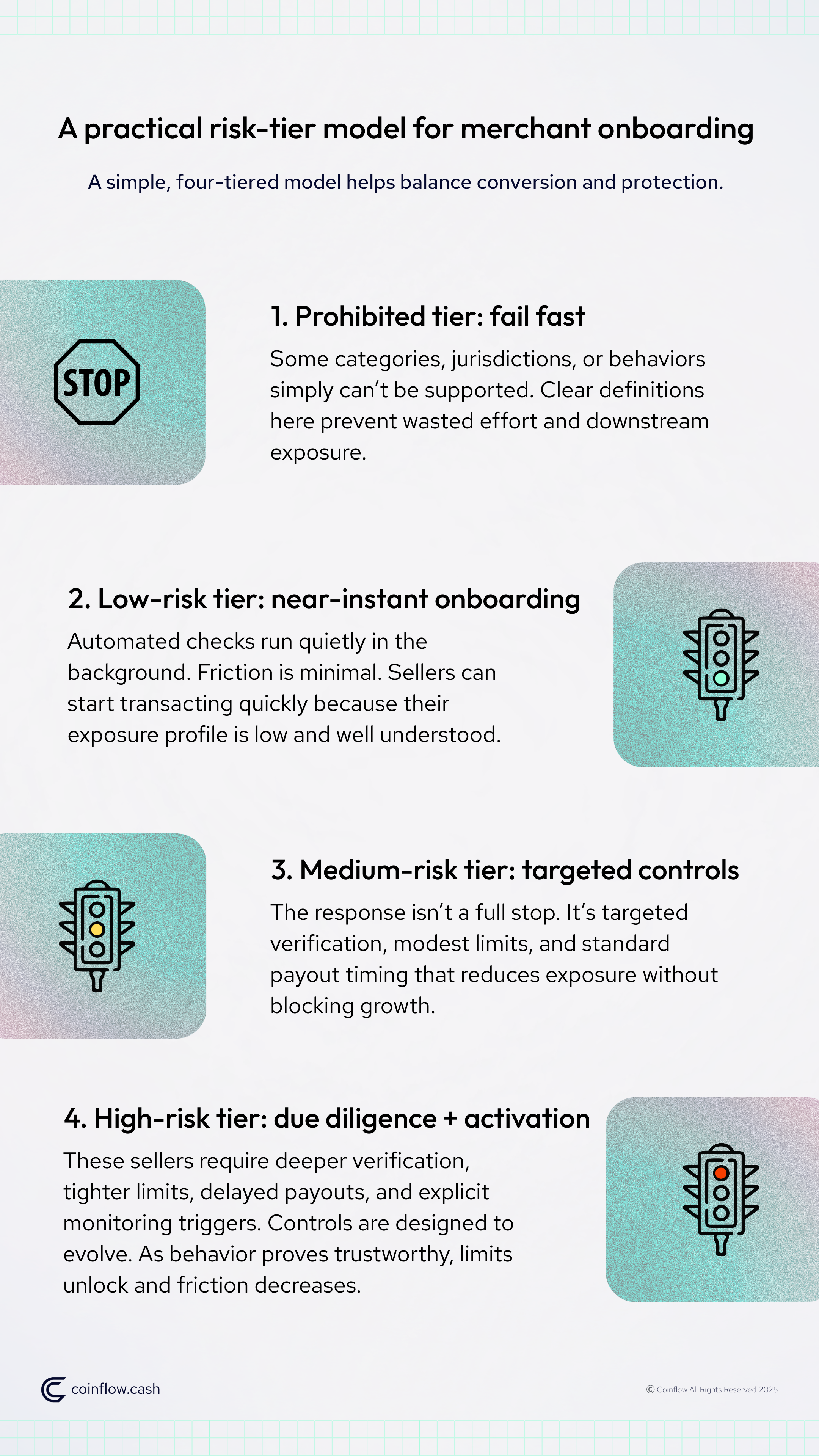
A simple, four-tiered model helps balance conversion and protection.
Some categories, jurisdictions, or behaviors simply can’t be supported. Clear definitions here prevent wasted effort and downstream exposure.
Failing fast is a feature. It protects your platform and saves legitimate sellers time.
Most sellers belong here.
Automated checks run quietly in the background. Friction is minimal. Sellers can start transacting quickly because their exposure profile is low and well understood.
This is where marketplaces win by preserving conversion for the ~80% of users who won't cause headaches.
Medium-risk sellers trigger specific signals. Maybe it’s a higher refund profile. Maybe it’s cross-border payouts. Maybe it’s a newer business model.
The response isn’t a full stop. It’s targeted verification, modest limits, and standard payout timing that reduces exposure without blocking growth.
High-risk doesn’t mean “no.” It means “not all at once.”
These sellers require deeper verification, tighter limits, delayed payouts, and explicit monitoring triggers. Controls are designed to evolve. As behavior proves trustworthy, limits unlock and friction decreases.
Trust is earned through performance, not paperwork alone.
A tiered model only works if the workflow supports it.
Before asking for paperwork, use signals like category alignment, geography, and basic entity data to filter early.
If approval is unlikely, don’t create unnecessary work for the seller or your team.
Validate entity registration, ownership structure, and EIN or TIN consistency. Detect shell entities and merchant account identity theft patterns early, before money moves.
Sanctions, PEP, and watchlist screening matter, but only when applied thoughtfully. The goal isn’t box-checking. It’s preventing regulatory exposure that can shut down money flows entirely.
Some signals matter more than others. Refundability, dispute likelihood, and liquidity impact are often better predictors of loss than surface-level attributes.
Prioritize what affects payouts and recovery.
Every decision should be explainable. Reason codes help internal teams understand why a seller is in a given tier and give sellers a clear path to unlock additional capability over time.
Approval should be treated as the start of activation, not the end of assessment.
Approval alone shouldn’t release funds.
Volume caps and ticket size limits reduce early exposure. Category or corridor restrictions prevent sellers from expanding into riskier activities before trust is established.
Delayed payouts and rolling reserves aren’t punishments. They’re alignment tools.
When refundability or dispute windows are long, payout timing should reflect that reality. Controls should match who ultimately absorbs losses.
Predictability matters. Sellers are far less frustrated when they understand what’s required to unlock higher limits and faster payouts.
Opaque controls create support tickets. Clear rules build trust.
Onboarding doesn’t end when the account goes live.
Watch for changes in transaction velocity, dispute rates, refund behavior, and geographic patterns. Risk often emerges gradually, not instantly.
Some abuse only becomes visible when you look across sellers. Coordinated behavior, repeated small transactions, or shared attributes can slip past isolated reviews.
Define clear thresholds for holding, restricting, or offboarding sellers. Just as important, define reinstatement paths when evidence supports it.
– Tamille Suhir, Risk & Compliance Analyst @ Coinflow
Monitoring keeps problems small enough to fix.
Risk becomes real when money moves.
The moment funds leave the platform, exposure shifts from theoretical to financial. Fast payouts paired with delayed settlement create gaps where refunds, disputes, or regulatory issues can surface before money is recoverable. When that happens, losses compound quickly and become difficult to contain.
That’s why onboarding decisions can’t be separated from payout design. Dispute and refund responsibility should inform how and when sellers are activated, not just whether they passed identity checks. Controls need to reflect who ultimately absorbs losses and how quickly exposure grows once payouts begin.
When onboarding and payout logic live in separate systems, risk hides in the handoff. Sellers appear approved, money flows, and only later does the true exposure become visible—often when it’s already too late to fix cheaply.
Most marketplaces struggle with this because their systems are fragmented. Marketing owns the sign-up form, Compliance owns the KYC provider, and Finance owns the payout schedule.
Coinflow brings those pieces together.
Onboarding, staged activation, payout timing, and risk controls are designed as one system. Approving a seller does not automatically mean releasing funds. Marketplaces get clear visibility into how money moves, where exposure increases, and which controls apply at each stage of a seller’s lifecycle.
That enables faster onboarding without taking on unnecessary risk. Sellers can be approved quickly, placed behind sensible limits, and gradually unlocked as trust is earned, without forcing teams into constant manual reviews or reactive policy changes.
High-risk merchant onboarding doesn’t require more friction across the board. It requires earlier segmentation, smarter activation design, and tighter alignment between onboarding decisions and payouts.
Marketplaces that treat onboarding as a system can grow without turning payments and risk into recurring fire drills.
If you want help designing that system for your marketplace, talk to our team. We’ll help you map the right onboarding tiers, activation controls, and payout strategy to your model.

Eric Mueller has a decade of experience playing high-stakes defense in fintech. From P2P payments at Venmo to crypto ATMs at CoinFlip to building fraud teams at Zero Hash, Eric is currently Compliance & Risk Manager at Coinflow.
Marketplaces
How can a marketplace pay sellers in seconds without fronting capital or taking on extra chargeback risk? Here's the five-step playbook we see work.

Marketplaces
Slow marketplace payouts push your best sellers to competitors. See how payout speed shapes seller retention, liquidity, and long-term platform growth.

Fintech
Real-time payments are projected to hit 22% of global transaction volume by 2028. Here's how marketplaces, e-commerce, gaming, payroll, remittance, and fintech platforms are using instant settlement to drive real business outcomes.