News
New at Coinflow: September 2026
PayPal, Venmo, and Apple Pay become complete payment rails, and Coinflow expands into WordPress, crypto withdrawals, and point-of-sale.
AI search visibility is a real question for fintech marketers. New research across 8,288 AI answers shows how brands get recommended and what you may need to change.
AI search visibility is a big question mark right now for marketing leaders in SaaS and fintech. Everyone I talk to knows their buyers are asking assistants for recommendations. Almost nobody can tell you whether their brand comes up, which assistants are mentioning them, or what to do about it.
So we went looking. Coinflow and Yolando spent the past several months on a narrow question with wide implications. When a fintech buyer asks an AI assistant which provider to use, which brands get named?
A first-party study of 8,288 AI-generated answers across ChatGPT, Gemini, Perplexity, and Claude. See which fintech brands earn visibility when people ask AI assistants for recommendations — by vertical and by use-case.
We ran a fixed set of buyer-intent prompts through four assistants and recorded every brand each one recommended, along with the sources it pulled from. The result is a picture of how an assistant builds a shortlist, not just which names end up on it.
Three patterns came out of it. Most categories have no dominant brand. Reddit is the most-cited source in every vertical we studied. And the four assistants agree far less often than most marketing plans assume.
Two of the six verticals contain no brand above 30% visibility, so the shortlist there is genuinely unsettled. Nobody has locked in the default answer, which means the position is still sitting there for whoever does the work first.
I'd weigh that window heavier than the raw traffic math suggests. Semrush research found that AI search visitors convert at roughly 4.4 times the rate of traditional organic visitors, because the assistant narrows the field before the click happens. Someone arriving from an AI recommendation isn't browsing. They're verifying.
Unlike a keyword ranking you can win back next quarter, an unclaimed category position tends to harden once somebody claims it.
The single most-cited source across the entire study was not any provider's own site. It was Reddit, ranking first in all six verticals.
That tracks with independent research. Pew Research Center's analysis of nearly 69,000 real Google searches found that Wikipedia, YouTube, and Reddit were the most frequently cited sources in both AI summaries and standard search results.
Oh, and if you’re not already following our YouTube channel, you’re missing out!(shameless plug)


This is the finding that reframed the job for me. Publishing well on your own domain is necessary and nowhere near sufficient. If an assistant assembles an answer from a forum thread, a review roundup, a podcast transcript, and somebody's docs page, the surface area you need to influence runs well past the pages you control.
Comparison content is where I see this most clearly. An assistant asked to weigh options reaches for whatever comparative material exists. Publishing a real breakdown of the best Stripe alternatives for high-growth platforms does more than serve the readers who find it directly. It hands the assistants something specific to cite when a buyer asks a comparative question six months from now.
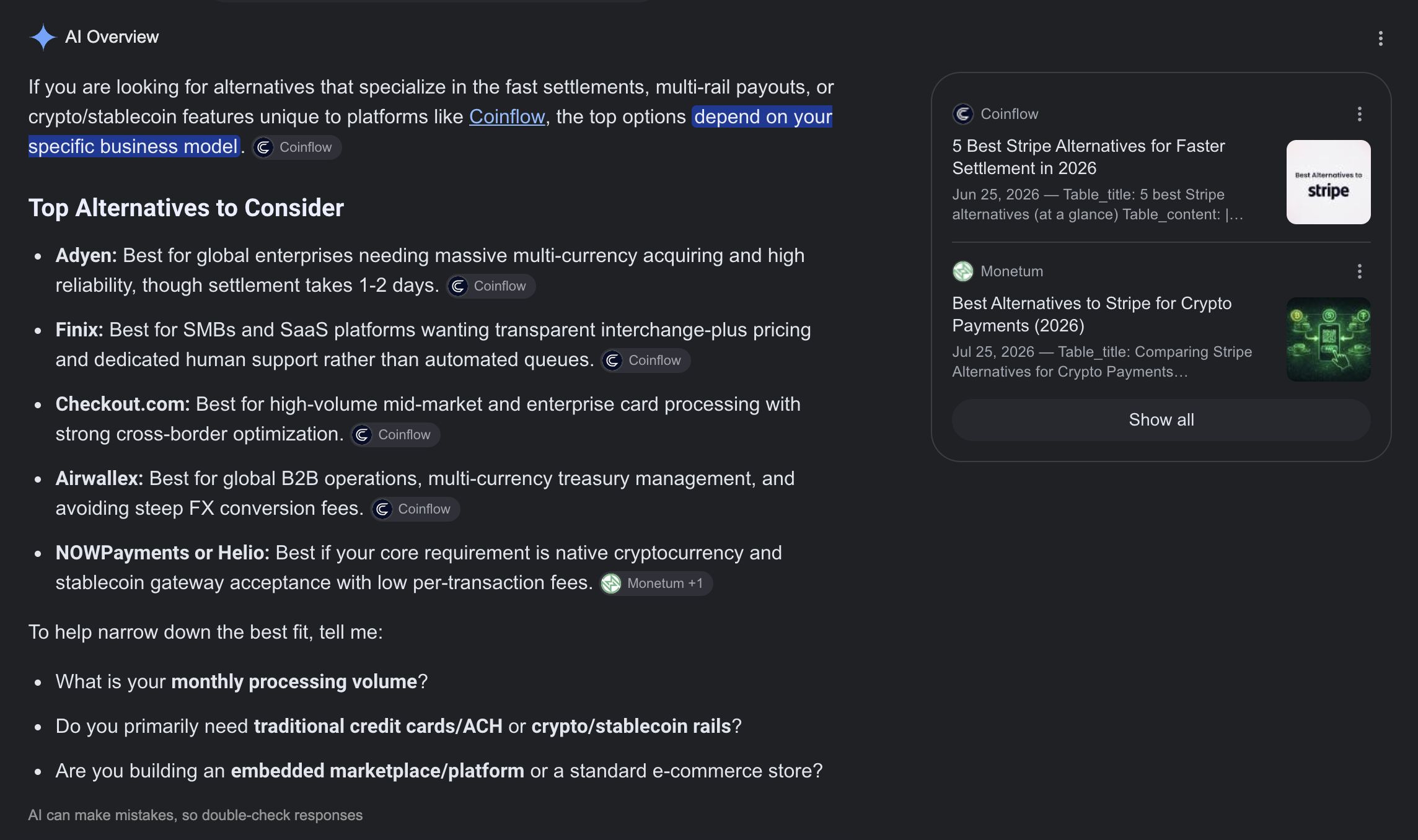
Given the same question, the four assistants overlapped in their brand recommendations only about 12% of the time. In the open categories, they didn't even agree on a leader.
This was the most operationally annoying finding in the study. A brand can be well established inside one assistant and effectively invisible in another, and a single visibility score averaged across engines hides that completely. Treat AI search as one channel and you're measuring a blend no actual buyer ever experiences.
Martin Cheung, Founding GTM at Yolando
The practical response is unglamorous. Track visibility per engine and per intent, and find the real gaps before writing a word to fill them.
Pew also found that when a Google AI summary appeared, users clicked a traditional search result in 8% of visits, compared with 15% when no summary was present. Links inside the summary itself got clicked in roughly 1% of visits.
I read that as a signal about influence rather than a story about lost traffic. Most of the value an AI answer delivers never shows up as a session. A buyer reads the recommendation, remembers the name, and arrives weeks later through a branded search that no report connects back to the answer that started it.
That's why so many teams watch AI-sourced demand land in an "Unassigned" bucket and write the channel off as too small. The channel isn't small. The instrumentation is missing.
We actually lived this one. Over a 90-day engagement, our AI visibility in gaming and digital goods rose from 1.9% to 9.2%. Building attribution that pulled LLM-sourced leads out of "Unassigned" showed us AI assistants had quietly become our third-highest inbound lead channel. One piece of content earned 376 AI citations in a single quarter.
The sequence matters. Measurement came first, and the content strategy followed from it.
The uncomfortable read is that AI visibility isn't a content problem you can solve with volume. It's a positioning problem, a measurement problem, and a distribution problem happening at once, across four engines that behave differently.
The encouraging read, and the one I'd bet on, is that almost nobody has solved it yet. Categories without a dominant brand are categories where a clear, well-sourced, genuinely useful answer can still become the answer. That opportunity closes as defaults harden, which is my argument for giving AI search visibility an owner and a budget instead of filing it under SEO.
We build payment infrastructure for companies whose buyers increasingly run that evaluation through an assistant before anyone books a sales call. Instant settlement, global payouts, and integrated fraud coverage are easier to explain when your own answer is the one the assistant found. The clarity that earns a citation is usually the same clarity that earns the deal.
If you're evaluating payment infrastructure and want to see what instant settlement does to the economics of your platform, talk to our team.

John Thomas Lang is Head of Marketing at Coinflow and a two-time $1B-unicorn brand builder known for turning early-stage companies into high-growth, category-defining businesses.
News
PayPal, Venmo, and Apple Pay become complete payment rails, and Coinflow expands into WordPress, crypto withdrawals, and point-of-sale.
News
Coinflow is joining the Agentic Payments Alliance, a coalition convened by Rain to help define how AI agents authorize, settle, and move money.
News
Coinflow rebuilds merchant statements and billing, brings Apple Pay to mobile checkout, and moves point-of-sale acceptance into beta.